

If your face feels tight five minutes after you wash it, stings when you put on sunscreen, or gets red and blotchy for no clear reason you can point to, you probably don't have a skin type problem. You have a barrier problem. I went through this myself two winters ago, layering on more serums to fix skin that was already inflamed, which is a lot like adding more weight to a sprained ankle and wondering why it still hurts every time you walk on it.
The fix isn't a 10-step routine, and it isn't an expensive serum either, no matter how good the packaging looks. It's usually the opposite: stripping back to almost nothing and rebuilding slowly, starting with the one product that touches your skin every single day and either helps it heal or quietly keeps wrecking it, your cleanser. I ended up switching to the La Roche-Posay Toleriane Hydrating Gentle Face Cleanser partway through my own repair process, on the recommendation of a dermatologist's office, and it's the one product I kept in rotation after everything else in my routine got pared back to almost nothing.
Start the reset with a cleanser that won't undo the work
Before you touch a single serum, swap your foaming face wash for something that won't strip your skin further. La Roche-Posay Toleriane is fragrance-free, soap-free, and formulated with ceramides, niacinamide, and glycerin, the ingredients your barrier actually needs to rebuild itself.
Amazon Check Today's Price on Amazon →Step 1: Figure out if it's actually your barrier
Before you change anything in your routine, take a minute to confirm what you're actually dealing with. A damaged barrier usually shows up as a cluster of symptoms together, not just one isolated thing. Tightness right after cleansing that doesn't ease up even after you apply moisturizer. Stinging or burning when you use products that never used to bother you, including sunscreen, toner, or even plain tap water on a cold day. Rough or flaky patches that show up in a new spot each week instead of staying in one predictable place. Redness that comes and goes without a clear trigger like sun, wind, or spicy food.
If you're nodding along to two or more of those, the skin's outer layer, the part that's supposed to keep moisture locked in and irritants and bacteria locked out, isn't doing its job the way it should. That layer gets compromised by over-exfoliating, stacking too many active ingredients at once, harsh sulfate cleansers, hot showers, over-washing your face out of habit, or a stretch of dry winter air that pulls moisture out of everything, skin included. Sometimes it's all of the above piled on top of each other at the same time, which is exactly what happened to me.
In my case, I'd been using a foaming cleanser twice a day because it felt "clean," a retinol three nights a week, and a vitamin C serum every single morning, all on top of an already dry Ohio winter and a bedroom with forced-air heat running nonstop. None of those individual things were wrong on their own. Plenty of people use all three without issue. Together, stacked on top of each other with no breaks, they were too much for my skin to keep up with, and it started telling me in the only language it has: constant irritation. It took me embarrassingly long to connect the dots, mostly because I kept assuming the answer was to add something new rather than take something away.
Step 2: Strip your routine down to the basics
This is the part people resist the most, because pausing your routine feels like giving up on progress you've already made. But you cannot build new skin on a foundation that's currently cracked, no matter how good the products layered on top of it are. For at least two weeks, pause every active ingredient in your routine. That means no retinol, no vitamin C, no exfoliating acids like glycolic or salicylic, no physical scrubs, and nothing labeled brightening, resurfacing, or renewing. Your routine during this window should be three things only: a gentle cleanser, a barrier-repair moisturizer, and sunscreen during the day.
This is where the cleanser choice actually matters more than most people expect it to. A lot of cleansers marketed as "gentle" still foam up when you use them, and foaming almost always means sulfates are in the formula, which strip your skin's natural oils right along with the dirt and makeup you're trying to remove. The Toleriane cleanser doesn't foam at all. It's a lotion-to-milk texture that you massage into damp skin and rinse off, and it left a filmy, slightly soft feeling on my face the first time I used it, which honestly worried me at first until I realized that film wasn't leftover residue, it was the ceramides and niacinamide doing exactly what they're supposed to do instead of getting rinsed straight down the drain.
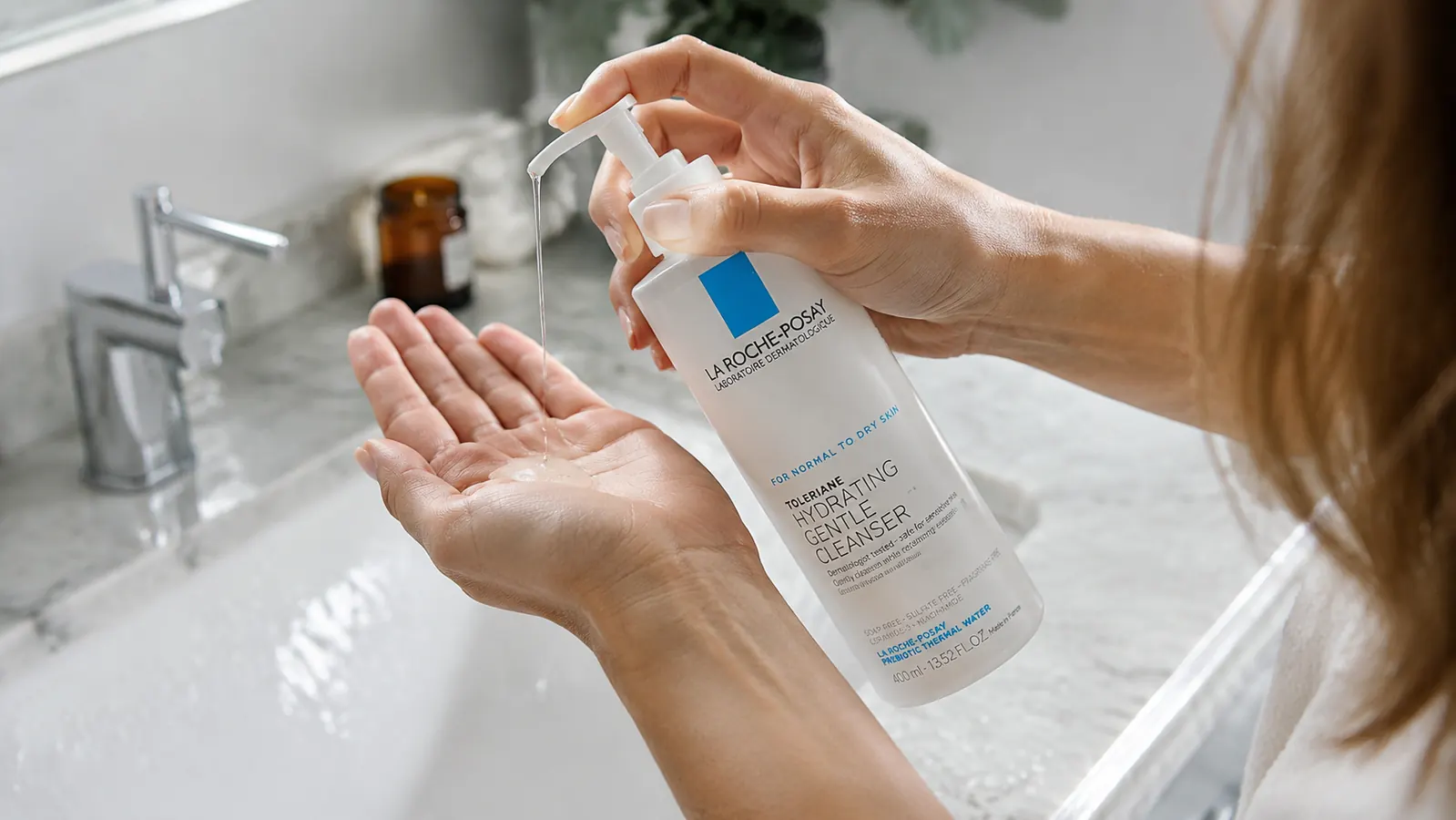
Use lukewarm water for this, not hot. Hot water feels satisfying in the moment, especially on a cold morning, but it strips lipids from your skin barrier faster than almost anything else in a normal routine. And resist the urge to scrub with a washcloth, cleansing brush, or exfoliating mitt during this window, even if that's been your habit for years. Fingertips only, for about 30 seconds of gentle circular motion, then pat your face dry with a clean towel rather than rubbing it, since rubbing creates friction your skin doesn't need on top of everything else it's dealing with.
Step 3: Layer moisture while your skin is still damp
There's a small window right after cleansing, while your face is still a little damp rather than bone dry, where moisturizer absorbs better and helps trap water inside the skin instead of letting it evaporate straight back out into the air. Dermatologists sometimes call this the three-minute rule, and it's one of the simplest changes you can make to a routine at zero extra cost, since you're not buying anything new, just changing your timing.
Look for a moisturizer with ceramides, glycerin, and either hyaluronic acid or squalane on the ingredient list. Skip anything with added fragrance, essential oils, or high alcohol content, all of which can sting compromised skin even if the exact same formula never bothered you a few months ago when your barrier was healthy. If your skin is actively flaking or peeling, it's fine to apply moisturizer twice, once right after cleansing and again about ten minutes later, both morning and night, until the flaking calms down.
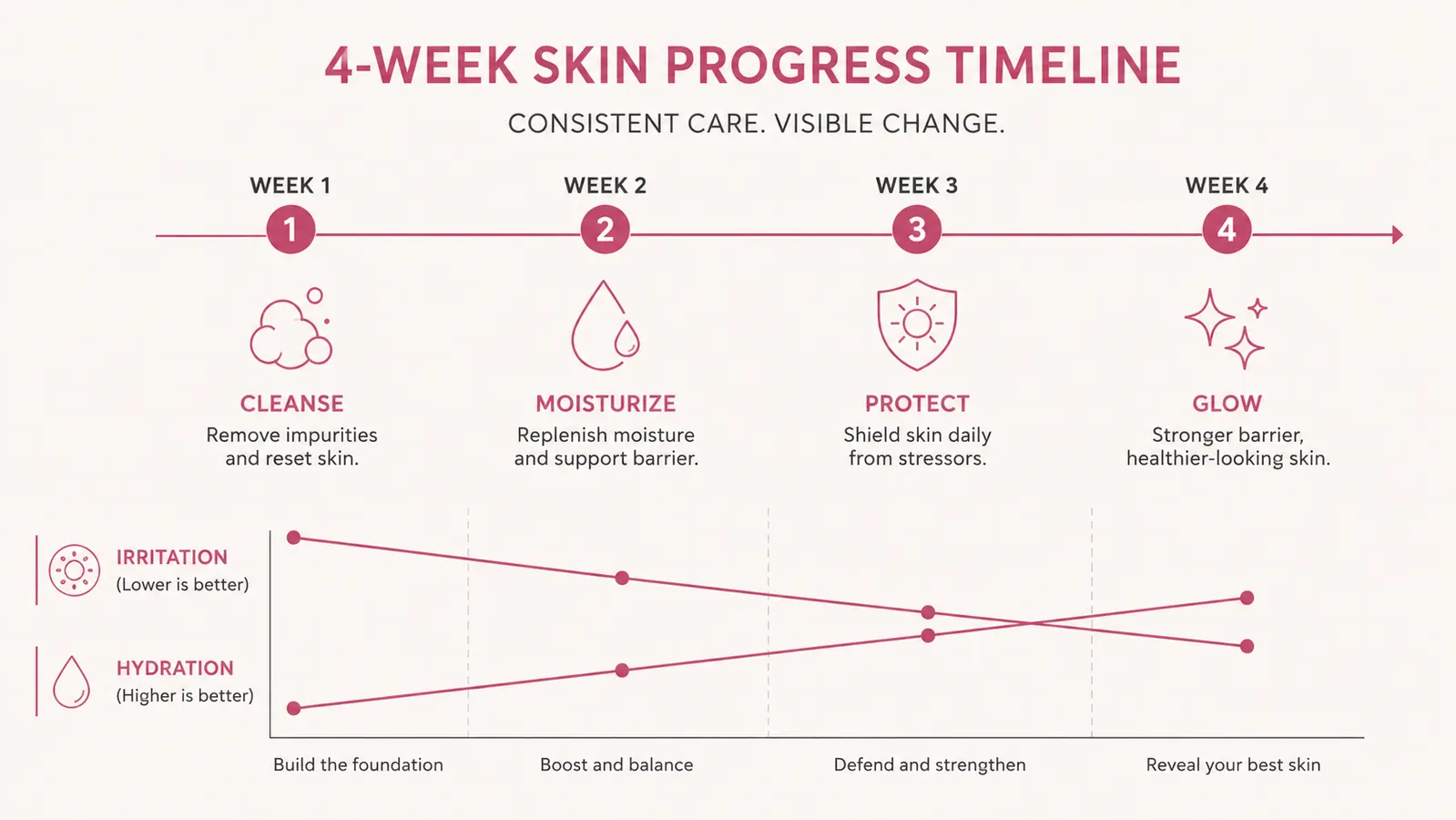
I noticed the constant tightness easing up within about four or five days of doing this consistently, which honestly surprised me because I expected it to take much longer. The visible flaking on my cheeks and around my nose took closer to two full weeks to calm down completely, so don't panic if the timeline for you looks a little different. Everyone's barrier heals on its own schedule, and stress, sleep, and diet all play a role in how fast that happens.
Step 4: Protect it every single morning, even indoors
Damaged skin is noticeably more sensitive to UV damage than healthy skin, and sun exposure is one of the fastest ways to undo the barrier repair progress you've already made. This step gets skipped constantly, especially by people who work from home most days or figure a cloudy, gray day doesn't really count. UV rays pass through cloud cover and window glass just fine, so skipping sunscreen because you're "just working from the kitchen table" doesn't actually protect you.
Use a mineral sunscreen with zinc oxide during the repair window if your skin can tolerate it, since chemical sunscreen formulas are more likely to sting skin that's already compromised and reactive. Apply it as the very last step of your morning routine, rain or shine, work-from-home day or not. This isn't an optional extra step if you actually want the redness and sensitivity to calm down for good instead of getting a little better indoors and then flaring right back up the moment you step outside for the mail.
Step 5: Reintroduce actives slowly, one at a time
Once your skin has gone about two weeks without stinging, tightness, or new flaking showing up, you can start adding one active ingredient back into your routine, and only one at a time. Not your whole old routine all at once, even if you're eager to get back to it. Pick the single ingredient that matters most to you, wait a full week watching how your skin reacts, and only then consider adding anything else on top of it.
A good order to reintroduce things in is a hydrating serum first, since those tend to be the least likely to cause any irritation at all, then a mild exfoliant used every third day instead of daily, then retinol last of all, starting at just twice a week instead of whatever frequency you were using before things went sideways. If irritation comes back at any point in this process, that's your signal to pull back to the basic three-step routine again for a few more days before trying that ingredient a second time.
I kept the Toleriane cleanser in rotation even after I added my other products back in, because it never once caused a reaction, not even the week I reintroduced retinol for the first time in over a month. It became the one constant in an otherwise changing routine, which is honestly the most useful thing a cleanser can be when your skin is this unpredictable.
What Else Helps
A few small habits outside the product routine itself sped things along noticeably. I switched my pillowcase to a fresh one twice a week instead of letting it go closer to ten days, since a barrier that's already under stress reacts more to oil and bacteria buildup than skin that's healthy and functioning normally. I also ran a humidifier in the bedroom overnight during the driest stretch of that winter, which made a real, noticeable difference in how tight my skin felt when I woke up each morning. And I made a conscious effort to stop touching my face throughout the day, which sounds like a minor detail but adds up fast when your skin is already inflamed and extra sensitive to friction and whatever's on your hands.
Diet and stress showed up more than I expected too. I didn't overhaul what I was eating, but I did notice my skin looked calmer on weeks when I was drinking more water and less coffee, and worse during a stretch of deadline stress at work, which tracks with what a lot of dermatologists say about cortisol and inflammation. None of that replaces the routine changes above, but it's worth paying attention to if you've done everything else right and progress still feels slower than it should.
The fastest way to heal a damaged barrier is to stop adding new problems to it while it's trying to repair itself.
Rebuild with the cleanser that won't fight your skin
If your face still feels tight or reactive after washing, the cleanser is the first thing worth changing. The Toleriane cleanser is fragrance-free, non-foaming, and dermatologist-tested for reactive skin, which makes it a safe constant while the rest of your routine gets rebuilt around it.
Amazon Check Today's Price on Amazon →